Peace through the rule of law
Awarded to Navi Pillay “for her efforts to promote peace and international law”.
1Pick your depth
What was the 2026 Nobel Prize in Peace awarded for?
The 2026 Nobel Peace Prize went to Navi Pillay, a South African judge who rose from defending the opponents of apartheid to serving on some of the most important international courts of her time. The Norwegian Nobel Committee honoured her for helping make sure that genocide, war crimes and crimes against humanity are prosecuted, including the 1998 ruling that rape and sexual violence can be acts of genocide.
2Guess first
Navi Pillay never negotiated a ceasefire or led a country. Why would a judge win the Peace Prize?
How close were you?
3Learn it at ELI5
Read the transcript
When Navi Pillay was a young lawyer in South Africa, apartheid laws kept her out of a judge's room because she was not white. No firm would hire her, so in 1967 she opened her own. In 1995 she became a judge. She later said the first judge's room she entered was her own. Later she judged at courts for the whole world. They punish the worst crimes, like trying to wipe out a whole group of people. That work won Navi Pillay the 2026 Nobel Peace Prize.
The 2026 Peace Prize went to Navi Pillay, a judge from South Africa. She grew up in the city of Durban under apartheid, a system of laws that kept people apart and unequal because of the colour of their skin. She became a lawyer and defended people who stood up against that system, among them Nelson Mandela.
Later she became a judge at international courts. These courts put people on trial when they are accused of the very worst crimes, such as trying to wipe out a whole group of people. Her work helped make sure that these crimes are punished and that the victims are heard.
Law instead of force
The Norwegian Nobel Committee says lasting peace needs rules that apply to everyone, strong or weak. In its words, peace requires justice. By honouring a judge, the Committee reminds the world that courts are one way to settle conflicts without violence.
Read the transcript
In 1973, a Durban lawyer named Navi Pillay won political prisoners on Robben Island, Nelson Mandela among them, the right to see lawyers. She spent 28 years defending opponents of apartheid. In 1994, after the genocide against the Tutsi, the UN Security Council set up a tribunal for Rwanda. Its judges tried those most responsible. Pillay was its president from 1999 to 2003. By the time it closed in 2015, the tribunal had convicted 61 people. From 2008 to 2014 she was UN High Commissioner for Human Rights, a post she called "the voice of the victim everywhere." The Norwegian Nobel Committee honoured her "for her efforts to promote peace and international law."
For most of history, the people who ordered mass killings rarely faced a court. After the Second World War, states built international law and UN institutions to change that. In November 1994, after the genocide against the Tutsi in Rwanda, the UN Security Council created the International Criminal Tribunal for Rwanda (ICTR), based in Arusha, Tanzania, to try those most responsible.
Pillay joined the tribunal as a judge in 1995 and was its president from 1999 to 2003. For its first four years she was its only woman judge. She was one of the three judges in its first trial, of Jean-Paul Akayesu, the former mayor of the Taba commune.
Rape recognised as an act of genocide
The tribunal found Akayesu guilty of genocide and crimes against humanity and sentenced him to life in prison. It was the first prosecution brought under the 1948 Genocide Convention. The judges held that rape and sexual violence can be acts of genocide when they are committed with intent to destroy a group, and that they can also be crimes against humanity. The Nobel Committee says Pillay's influence was a significant factor in that finding.
“From time immemorial, rape has been regarded as spoils of war. Now it will be considered a war crime.”Navi Pillay, after the Akayesu verdict
Her path through the courts
- 1967: opens her own law firm in Durban, the first non-white woman to do so in Natal province, because no firm would employ her. She defends opponents of apartheid and, in 1973, wins political prisoners on Robben Island, Mandela among them, the right to see lawyers.
- 1995: appointed to the High Court of South Africa, its first non-white woman judge.
- 2003 to 2008: judge at the International Criminal Court, the first permanent court that can try individuals for genocide, crimes against humanity, war crimes and aggression.
- 2008 to 2014: UN High Commissioner for Human Rights, a post she called 'the voice of the victim everywhere'.
- 2019 onward: ad hoc judge at the International Court of Justice in the genocide case The Gambia brought against Myanmar. From 2021 to 2025 she also chaired the UN commission of inquiry on the Occupied Palestinian Territory.
Read the transcript
On 2 September 1998, in Arusha, the Rwanda tribunal found Jean-Paul Akayesu guilty of genocide. He had been mayor of the Taba commune. Navi Pillay, this year's Peace laureate, was one of its judges. It was the first prosecution under the 1948 Genocide Convention. The judges held that rape and sexual violence can be acts of genocide. They can also be crimes against humanity. The chamber found that in Taba, these acts against Tutsi women were part of the intent to destroy the Tutsi group. Akayesu was convicted on 9 of 15 counts and sentenced to life imprisonment. Tribunals like the one in Arusha try individuals. Disputes between states go to the International Court of Justice. Since 2019, Pillay has sat on that court as an ad hoc judge. The Gambia chose her for its case accusing Myanmar of genocide against the Rohingya.
The Committee placed this prize in a long line. It noted that the first Peace Prize, awarded 125 years ago, already stressed settling conflicts through international law, and that the post-war UN system rested on one insight: lasting peace must be built on legal principles, not on the will of the strong or a fragile balance of power. It was also frank that this order has never been perfect. The greatest powers have often escaped responsibility, and outcomes have depended on who the perpetrator and the victim were.
Precedents from Arusha
Akayesu was the first time the Genocide Convention was enforced in court, and it brought sexual violence inside the legal definition of genocide. The Committee credits Pillay with a second breakthrough: for the first time, a defendant faced charges of incitement to commit genocide purely for spreading propaganda. She also sat on the tribunal's Media Case against leaders of the radio station RTLM and the newspaper Kangura, which in December 2003 convicted all three defendants of crimes that included incitement to genocide.
Context, impact, and the debate
- A message about timing: the Committee said international law is under heavy pressure, its institutions are attacked and its judges are sanctioned. It framed the prize as a reminder that whenever might overtakes right, stability and trust suffer.
- Courts with limits: critics have faulted the Rwanda tribunal for not prosecuting crimes by the Rwandan Patriotic Front, a charge some described as 'victor's justice'. Its time limit to events of 1994 also left later crimes outside its reach.
- Disputed stances at the UN: as High Commissioner she drew criticism from several sides. Sri Lanka's government and its supporters said her Tamil descent drove her criticism of its conduct at the end of the civil war, a claim she denied. Civil society groups in Zimbabwe criticised her 2012 call to suspend sanctions there. In 2014 more than 100 members of the US Congress wrote that the Human Rights Council could not be taken seriously after it opened an inquiry into Israel's conduct in Gaza.
- The Gaza commission: the UN commission she chaired found in 2024 that both Hamas and Israel had committed war crimes, and in September 2025 concluded that Israel had committed genocide in Gaza. Critics such as the Jerusalem Center for Public Affairs called her comments antisemitic, and the United States and European governments objected to the commission's open-ended mandate. Pillay replied that the occupation has no end date either.
Her career runs through almost every kind of body the modern system uses: a national court, an ad hoc UN tribunal, a permanent criminal court, the UN's human rights office, a commission of inquiry, and the court that hears disputes between states. The open question, which the Committee itself raised, is whether those institutions can hold the powerful to the same standard as everyone else.
Her first time in a judge's chambers
Under apartheid, Pillay was not allowed to enter a judge's chambers because she was not white. In 1995, nominated by President Nelson Mandela, she was appointed to the High Court of South Africa, the first non-white woman to sit there. Mandela called to congratulate her in person. As she later said, the first time she entered a judge's chambers was when she entered her own.
4Check yourself
What did the Rwanda tribunal establish in the Akayesu judgment of 1998?
How did Pillay begin her legal career in 1967?
Which of these roles has Pillay NOT held?
Key terms
- Apartheid
- The system of racial segregation and discrimination enforced by law in South Africa, under which Pillay grew up and worked as a lawyer.
- Genocide
- Acts committed with intent to destroy, in whole or in part, a national, ethnic, racial or religious group, as defined in the 1948 Genocide Convention.
- Crime against humanity
- A serious crime, such as murder, torture or rape, committed as part of a widespread or systematic attack against a civilian population.
- ICTR
- The International Criminal Tribunal for Rwanda, a temporary UN court set up in 1994 in Arusha, Tanzania, to try those responsible for the Rwandan genocide. It closed at the end of 2015.
- International Criminal Court (ICC)
- A permanent court created under the Rome Statute in 2002 that tries individuals for genocide, crimes against humanity, war crimes and aggression when national courts are unwilling or unable to.
- International Court of Justice (ICJ)
- The UN court that hears disputes between states, such as the genocide case The Gambia brought against Myanmar.
- Ad hoc judge
- A judge added to the ICJ bench for a single case when a party has no judge of its nationality on the court. The Gambia chose Pillay.
The laureate
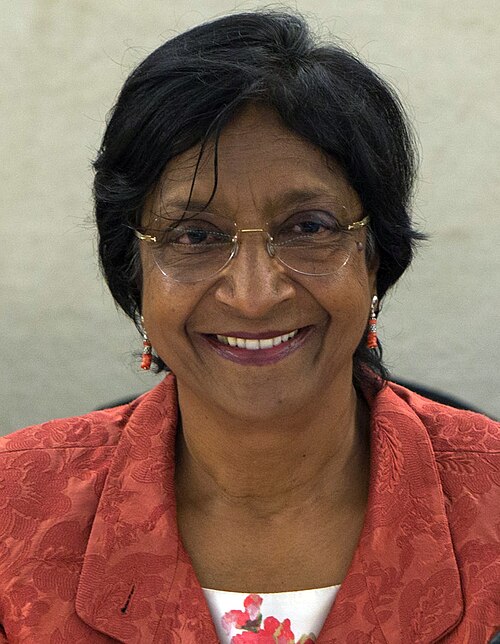
Born in Durban in 1941 into a family of Indian Tamil descent, Navanethem Pillay opened her own law firm in 1967 and spent 28 years as a lawyer defending opponents of apartheid. She earned a doctorate in law at Harvard in 1988 and in 1995 became the first non-white woman judge on South Africa's High Court. She then served on the International Criminal Tribunal for Rwanda (its president from 1999 to 2003), on the International Criminal Court, and as UN High Commissioner for Human Rights from 2008 to 2014.
Sources
Facts are pinned from the official Nobel Prize API. The explanations were written from these sources: